 Freezedry Harvest
Seasonings
Pieces you can see in the blend,
dried without hot air.
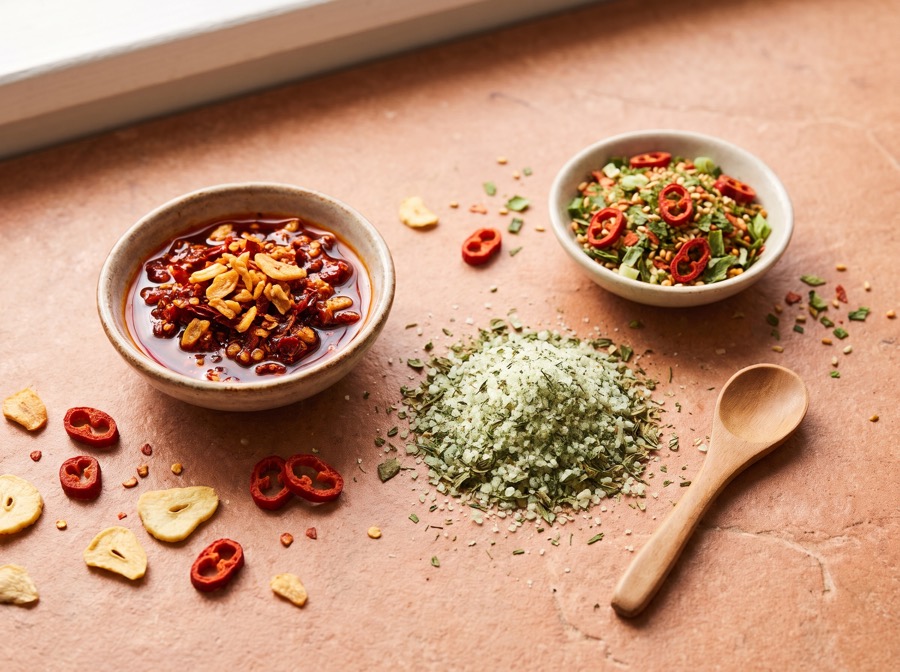
Freeze-dried herbs, rings and dice give seasoning blends, chili crisp, furikake-style toppings and herb salts visible pieces that keep their cut and much of their green color. They are dried without hot air and finish very dry, so they mix and flow well. We supply them certified organic, as single ingredients or as custom powders and blends.
01 — Where they go
Seasoning formats that use freeze-dried pieces.
Each format below uses cuts that are in our range now. The herbs and vegetables are certified organic.
- Chili crisp and chili oils. Red and green chili rings, diced garlic and diced onion, added to the oil after frying or as a dry topping.
- Furikake-style toppings. Spring onion and chive rings, chili rings and herb flakes alongside seeds and seaweed, where every piece is on show.
- Herb salts. Rosemary and thyme leaves, dill, basil and oregano flakes, mixed with coarse salt for a blend a shopper can read at a glance.
- Rubs and grill blends. Diced garlic, onion and ginger with chili rings and thyme leaves, coarse enough to stay on the meat.
- Snack and popcorn seasonings. Powders milled from our cuts to your specification, for an even coat.
- Dips and dairy blends. Chive rings, dill and parsley flakes and diced garlic for dry dip mixes.
- Curry and Southeast Asian blends. Curry leaves, lemongrass rings and diced ginger.
02 — Pieces or powder
Visible pieces and powders do different jobs.
Most blends use both: a powder carries the flavor evenly, and pieces tell the shopper what is inside.
| Visible pieces (rings, leaves, flakes, dice) | Powder (milled to your specification) | |
|---|---|---|
| What it does in the blend | Shows the ingredient; adds a bite and a burst of aroma when crushed or chewed | Spreads flavor and color evenly across every portion |
| Best formats | Chili crisp, furikake-style toppings, herb salts, rubs, grinder blends | Snack and popcorn seasonings, sauce and soup bases, coated nuts |
| Segregation risk | Pieces of different size can separate in the pack | Low once mixed |
| Flow | Generally free-flowing when dry | Fine powders can cake in humid air |
| From FD Harvest | Rings, leaves, flakes and dice from the standing range | Single-ingredient powders made only when you ask; organic powders available |
Products are single ingredients. Custom cuts, powders and blends are developed with you, piloted small at the plant, then scaled, with no minimum order.
03 — Color and aroma
Less heat means less of the color and oil driven off.
Heat causes most of what a herb loses in drying: hot air drives off volatile oils, breaks down chlorophyll and speeds up browning. Freeze drying removes water as vapor from frozen product at low temperature, so less of that damage happens.
The published trials point the same way but are not uniform. Freeze-dried chives held about 1.6 times the chlorophyll of hot-air-dried chives in one study, and freeze-dried dill and spearmint kept more of their aroma compounds than hot-air-dried samples. In basil, parsley and bay, slow shade drying at room temperature lost fewer volatiles than freeze drying in small lab trials. None of these methods keeps everything a fresh herb has.
For a seasoning, freeze-dried pieces usually look greener and smell stronger than hot-air-dried ones, but the test that counts is yours. The method side by side is in freeze drying compared with air drying.
04 — Moisture and flow
What keeps a blend dry and free-flowing.
A seasoning fails when it cakes or turns soft. Settle these terms with your supplier before you scale.
- Moisture
- Freeze-dried ingredients typically finish at a few percent moisture. Spec limits for conventionally dried herbs are often set around 8–12%. The moisture target for each of our ingredients is on its spec sheet and agreed with you at trial.
- Water activity
- How free the water in an ingredient is to move. In a blend, moisture travels from the ingredient with the higher water activity to the lower one, so a dry herb next to a damp salt will soften.
- Hygroscopic
- Freeze-dried pieces are porous and pull moisture from the air. Blend in a dry room and pack in a film with a good moisture barrier.
- Oil-based products
- In chili crisp the pieces sit in fat, not water, so they stay crisp longer than in a water-based sauce. Add them after the oil has cooled below frying heat if you want to keep the color.
- Ready-to-eat use
- Drying is not a kill step, freeze drying included. In a dip mix or topping eaten without cooking, set your micro specification with care. Our lots are micro-tested in our own lab.
05 — Questions
Questions buyers ask about freeze-dried herbs for seasonings.
Why use freeze-dried herbs in a seasoning blend instead of air-dried?
Freeze-dried herbs are dried without hot air, so in published trials they usually keep more green color and aroma than hot-air-dried herbs, and the pieces keep their cut. Results vary by herb, so compare samples in your own blend.
Can freeze-dried chili and garlic be used in chili crisp?
Yes. Freeze-dried chili rings, diced garlic and diced onion are used in chili crisp, added to the oil after frying or sprinkled as a dry topping. All three are in the FD Harvest range and certified organic.
Do you make seasoning powders?
Yes, to your specification. We supply single ingredients and make powders only when you ask; organic powders are available.
Can you make a custom seasoning blend?
Yes. Custom blends are developed with you, piloted small at the plant, then scaled, with no minimum order. You choose the ingredients, the cuts and the proportions.
How do I stop a herb seasoning from caking?
Keep every ingredient at low, matched water activity, blend in a dry room and pack in a film with a good moisture barrier. Freeze-dried herbs finish very dry, which helps, but they take up moisture from humid air.
Are freeze-dried herbs for seasonings available organic?
Yes. The herbs and vegetables in the FD Harvest range are certified USDA Organic and EU Organic by Ecocert, so they can go into an organic seasoning. The certificate is available on request.
Contact us to discuss your product requirements.
Tell us the blend and the cuts you have in mind. We send free samples with a spec sheet for each ingredient.
Contact usSources
- Chen et al., drying methods and chive chlorophyll, Modern Food Science and Technology (2020)
- Huopalahti R. et al., aroma of dried dill, Agric. Food Sci. 57 (1985)
- Antal T. et al., Effect of drying methods on the quality of the essential oil of spearmint leaves, Drying Technology 29(15) (2011) 1836–1844
- Díaz-Maroto M.C. et al., drying methods and basil volatiles, J. Sci. Food Agric. (2004)
- Ratti C., Hot air and freeze-drying of high-value foods: a review, J. Food Eng. 49 (2001)
- CBI, thyme market entry (ESA quality minima)
- FDA, Risk Profile: Pathogens and Filth in Spices (2017)