 Freezedry Harvest
Glossary
The words on a freeze-dried spec sheet,
defined in plain terms.
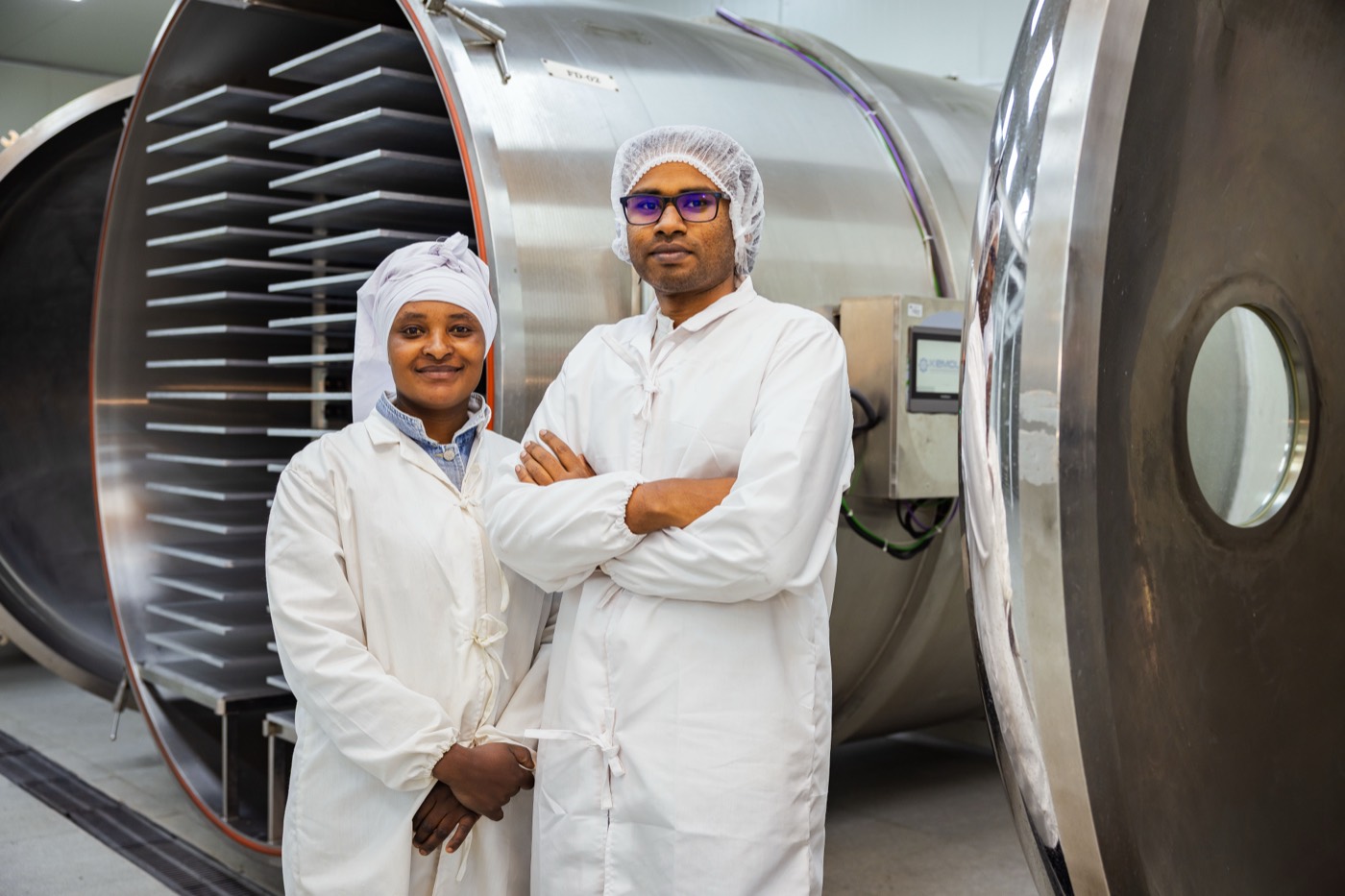
Freeze drying removes water from frozen food by sublimation under vacuum. This glossary defines that term and the others a product developer meets when buying freeze-dried ingredients: drying methods, water activity and moisture, cut forms and packaging, certifications and shipping terms.
01 — Process terms
How the ingredient is dried.
Terms for freeze drying and the drying methods it is compared with. The freeze-drying guide compares them side by side.
- Freeze drying (lyophilisation)
- A drying method that removes water from frozen food by sublimation under vacuum. The product stays cold while it dries, so pieces keep their shape, cut and much of their color and aroma. Lyophilisation (lyophilization in US spelling) is the technical name for the same process.
- Sublimation
- The change of ice straight into water vapor without melting first. It happens at low pressure, which is why freeze drying takes place in a vacuum chamber.
- Primary drying
- The main stage of freeze drying, in which a vacuum is pulled and the shelves are warmed gently so the ice sublimes. The drying front moves from the outside of each piece inward, and the product temperature is held below a set maximum. It is the longest stage.
- Secondary drying
- The final stage of freeze drying. Once the ice is gone, a small amount of water is still bound to the cell material, and a small rise in temperature drives it off.
- Dehydrated (hot-air dried)
- Dried by passing heated air over the product on trays or belts. Hot-air drying keeps the cut but tends to shrink and case-harden pieces, and heat drives off volatile oils and breaks down chlorophyll. "Dehydrated" on a label usually means this method.
- Sun dried
- Spread in the open and dried by sun and air over days. It is low cost and keeps the cut, but the crop is exposed to dust, insects, birds and weather while it dries.
- Spray dried
- A liquid feed such as a juice or extract is sprayed as a fine mist into hot air and dries in seconds to a powder. Spray drying makes powders only; there is no piece or cut to keep.
- IQF (individually quick frozen)
- Pieces frozen separately so they do not clump. IQF food is frozen, not dried: it stays close to fresh but needs a frozen cold chain, which a freeze-dried ingredient does not.
02 — Quality and measurement
What a spec sheet measures.
Terms for the properties a quality team checks on a dried ingredient.
- Water activity (aw)
- A measure of how much of the water in a food is free to support microbial growth or chemical change, on a scale from 0 to 1. No microbial growth occurs below an aw of 0.60. Freeze-dried powders typically measure 0.20–0.35 in published studies.
- Moisture content
- The share of a product's weight that is water, usually given as a percentage. Freeze-dried fruit and vegetables typically finish under 3% residual moisture; the target for a specific ingredient is set on its spec sheet.
- Rehydration ratio
- The weight of a dried ingredient after it has soaked up water, divided by its dry weight. It depends on the crop, the piece size and the water temperature, so there is no single figure for freeze-dried food. Porous freeze-dried pieces generally take up water faster than hot-air-dried pieces.
- Bulk density
- The weight of a loose, dry ingredient that fills a given volume, including the air between pieces. It matters for pack sizes, dosing equipment and how a blend settles. Freeze-dried pieces are light for their size because they are porous.
- Micro testing
- Laboratory tests of a lot for microorganisms such as bacteria, yeasts and molds. At FD Harvest, lots are micro-tested in our own lab.
- Shelf life
- The time a product keeps its stated quality under stated storage conditions. Freeze-dried ingredients take up moisture and oxygen from the air, so shelf life depends on the packaging staying sealed. FD Harvest ingredients have a shelf life of 3 years in sealed packaging.
03 — Forms and packaging
Cuts, uses and the pouch.
Terms for the physical form of an ingredient and how it is packed.
- Cut form
- The shape an ingredient is cut to. Common freeze-dried cuts are rings (chives, spring onion, chili, lemongrass), leaves (thyme, rosemary, bay), chopped flakes (basil, parsley, cilantro), diced (garlic, ginger, onion), pieces (tomato, sweet corn, fruit) and powder.
- Powder
- An ingredient milled to a fine, free-flowing form. A freeze-dried powder is milled from the dried crop; a spray-dried powder is dried from a liquid. At FD Harvest, products are single ingredients and are powdered only when you ask.
- Blend
- A mix of two or more ingredients made to a set recipe, such as a herb mix or a seasoning base. A blend has its own specification, separate from the specs of its parts.
- Inclusion
- A visible piece added to a food, such as fruit pieces in cereal, granola, bars, chocolate or yogurt. Freeze-dried inclusions stay crunchy at low water activity; in a moist matrix they need a barrier or matched water activity.
- Topper
- An ingredient sprinkled on top of a finished food for flavor, color or texture, such as herb flakes on a soup or a dry topper on pet food.
- Metalized pouch
- A flexible bag made from plastic film with a thin metal layer, which blocks moisture, oxygen and light better than plain film. FD Harvest packs freeze-dried ingredients in metalized pouches, each with a lot number.
- Oxygen barrier
- A packaging layer that slows oxygen passing into the pack. Oxygen dulls color and flavor and can oxidize fats over time, so dry ingredients are packed in barrier materials.
04 — Sourcing and paperwork
Certificates, records and shipping terms.
Terms a buyer meets in supplier approval and purchasing. Our own certificates are listed on the about page.
- Lot (lot code)
- A quantity of product made under the same conditions, identified by a code printed on the pack. The lot code links a pouch to its production records.
- Traceability
- The ability to follow a lot back to its origin and forward to where it went. At FD Harvest, every lot is traceable from field to pouch: farm, plot, harvest date, dryer run and packing date.
- Spec sheet
- A supplier document that describes an ingredient: what it is, its cut, its quality limits such as moisture, and its storage and shelf life. At FD Harvest, every ingredient has one, with the moisture target agreed with you at trial.
- HACCP
- Hazard Analysis and Critical Control Points: a method for finding the food-safety hazards in a process and controlling them at set points. It is the base of most food-safety certification schemes.
- FSSC 22000
- A food-safety management certification scheme built on ISO 22000 and recognized by the Global Food Safety Initiative. The FD Harvest plant is certified to FSSC 22000 by Intertek.
- PCQI
- Preventive Controls Qualified Individual: a person trained to prepare and oversee a food safety plan under the US Food Safety Modernization Act. FD Harvest has a PCQI on staff.
- Organic certification (USDA, EU)
- Independent confirmation that a crop is grown and handled under organic rules, such as the USDA National Organic Program or EU organic regulation. FD Harvest's herbs and vegetables are certified USDA Organic and EU Organic by Ecocert.
- Kosher (OU)
- Certification that a food or plant meets Jewish dietary law, given by a kosher agency. OU is the mark of the Orthodox Union, which certifies the FD Harvest plant.
- FDA food facility registration
- Registration with the US Food and Drug Administration required of facilities, in the US and abroad, that make, pack or hold food for US consumption. The FD Harvest plant is an FDA-registered food facility.
- Export processing zone (EPZ)
- A designated area where companies produce goods for export under a set customs and regulatory framework. FD Harvest's farms, plant and lab sit inside one export processing zone at Lake Naivasha.
- AGOA
- The African Growth and Opportunity Act, a US trade law that gives eligible goods from eligible sub-Saharan African countries duty-free entry into the US. FD Harvest ingredients enter the US duty-free under AGOA, extended to December 31, 2028.
- Incoterm
- One of the standard trade terms published by the International Chamber of Commerce, such as FOB, CIF or DAP. An incoterm states where the seller's responsibility for the goods, the cost and the risk passes to the buyer.
- Pilot run
- A first small production run made to confirm an ingredient works at scale before regular supply. At FD Harvest, a pilot run is developed with you and run small at the plant, with full paperwork and no minimum order.
- Private run
- A production run made to one customer's own specification, such as a custom cut, powder or blend. At FD Harvest, private runs are developed with your team, piloted small at the plant, then scaled.
- Co-manufacturing
- Making a product for another company to that company's specification, under its brand. The co-manufacturer supplies the plant and the process; the customer owns the recipe and the brand.
Questions
Questions about freeze-dried terms.
Is lyophilised the same as freeze-dried?
Yes. Lyophilisation is the technical name for freeze drying: water is removed from frozen food by sublimation under vacuum.
What is the difference between freeze-dried and dehydrated?
Freeze-dried food is frozen and then dried under vacuum at low temperature, so it keeps its shape and cut. Dehydrated usually means hot-air dried, which uses heat and tends to shrink pieces and drive off more of the volatile oils.
What is the difference between water activity and moisture content?
Moisture content is how much water a product holds by weight. Water activity measures how much of that water is free to support microbes or chemical change, and no microbial growth occurs below an aw of 0.60.
What is a rehydration ratio?
It is the weight of a dried ingredient after soaking, divided by its dry weight. It depends on the crop, the cut and the water temperature, so test it in your own product.
Is freeze drying a kill step?
No. Freeze drying lowers water activity so microbes cannot grow, but it does not kill what is present. That is why lots are micro-tested in our own lab.
Contact us to discuss your product requirements.
Tell us which ingredients, which cut, and what you are making, and we will ship free samples from the plant with a spec sheet for each.
Contact us