 Freezedry Harvest
Drying methods compared
Freeze dried or air dried:
what changes in the ingredient.
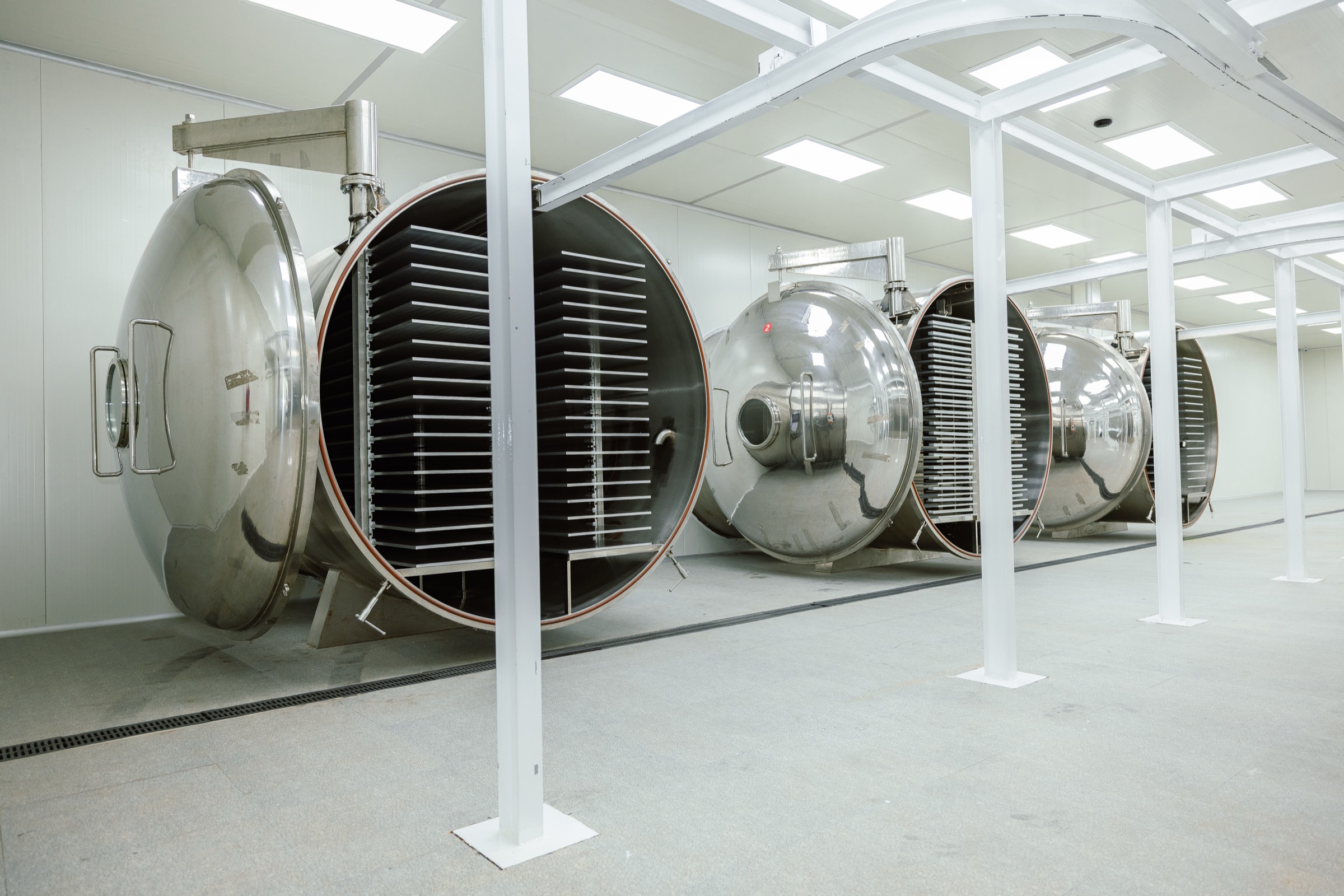
Freeze-dried herbs and vegetables are frozen, then dried under vacuum without heat damage, so they keep their cut, more of their color and aroma, and rehydrate in minutes. Hot-air-dried (dehydrated) ingredients cost less to make but shrink, darken and lose more volatile oil. Sun drying is cheapest and least controlled; spray drying makes powders only.
01 — The short answer
The difference is heat, and what heat does to a leaf.
Every drying method removes water; what differs is how. Freeze drying freezes the crop solid and turns the ice straight into vapor under vacuum, so the product stays cold and keeps its shape. Hot-air drying, often called dehydrating, evaporates the water with heated air. Sun drying leaves the crop in the open air for days. Spray and drum drying start from a liquid or a puree and make only powders or flakes.
Heat drives most drying losses: volatile oils evaporate, chlorophyll breaks down and heat-sensitive compounds degrade. Freeze drying keeps the cut and reaches a very low moisture without that heat, at the price of slower, more costly processing. For the process itself, see the freeze-drying guide.
02 — Property by property
How the drying methods compare for herbs and vegetables.
Typical values from the published literature, not FD Harvest specifications. Results vary by crop, cut and process; where the sources give no figure, the cell is qualitative.
| Freeze dried | Hot-air dried (dehydrated) | Sun dried | Spray or drum dried | |
|---|---|---|---|---|
| How it works | Frozen solid, then dried under vacuum in a closed chamber; the ice turns to vapor without melting, at low product temperature. | Heated air over trays or belts; liquid water evaporates. Published herb and vegetable trials run at about 40–80 °C. | Spread in the open and dried by sun and air over days. | Spray: a liquid is atomized into hot air and dries in seconds. Drum: a puree dries on a steam-heated drum in a few seconds of contact. |
| What comes out | Rings, leaves, flakes, dice and pieces that keep their cut, or a powder milled from them. | Keeps the cut, but pieces shrink and harden at the surface. | Keeps the cut; pieces shrink as water evaporates. | Powders (spray) or flakes and powders (drum) only. No leaf, ring or dice. |
| Aroma and volatile oils | No hot air to drive oils off. In dill, the key aroma compound kept 3.5–20% of its fresh level after freeze drying, against trace to 1.3% after hot-air drying. Still only about a quarter of fresh dill's total aroma compounds. | Hot air drives off a substantial share of the volatile compounds. | In small lab trials on basil, slow shade drying lost fewer volatiles than freeze drying. | The crop is juiced or pureed first; heat exposure is short. |
| Color | Green herbs keep more of their chlorophyll and stay greener than hot-air-dried herbs. Not identical to fresh. | Chlorophyll breaks down and browning speeds up with heat. | Days of light and heat; color loss is common. | A uniform powder; color depends on the feed and the heat exposure. |
| Moisture | Under 3% is typical for freeze-dried fruit and vegetables; 1.5–4% is reported for freeze-dried powders. | A maximum in specs, around 8–12% for conventionally dried herbs: 12% thyme, 10% rosemary (European Spice Association minima); 8% for dehydrated vegetables (Kenya standard). | Depends on weather and drying time; the same maximum limits apply. | Set by the process for each powder. |
| Water activity | 0.20–0.35 is reported for freeze-dried powders, and a well-designed process can get below 0.2. Microbes cannot grow below 0.60. | Low when dried to spec; depends on the final moisture reached. | Depends on the final moisture reached. | Low when dried to spec. |
| Microbiology | Not a kill step. Dried in a closed vacuum chamber; low water activity stops growth but does not kill what is present. | Not a kill step. Quality depends on the crop that goes in and how it is handled. | Not a kill step. The crop is exposed to dust, insects, birds and animals while it dries (FDA). Salmonella can survive more than a year in low-moisture foods. | Not a kill step. Depends on the feed that goes in and how it is handled. |
| Texture and rehydration | Porous. In carrot trials, water entered freeze-dried pieces about 100 times faster than air-dried pieces. Pieces come back close to their original shape in minutes. | Shrunken and case-hardened; rehydrates more slowly and does not fully recover. One secondary source gives onion rehydration ratios of about 1:1.5 hot-air dried against 1:1.8 freeze dried. | Shrunken pieces; rehydrates slowly. | Powders disperse or dissolve; there is no piece to rehydrate. |
| Heat-sensitive compounds | Product stays cold. In mango, vitamin C was 8.36 mg per 100 g fresh and 8.34 after freeze drying, not significantly different; beta-carotene fell by 26%. | Vitamin C degrades with temperature. Above about 70–80 °C, gingerols in ginger begin to convert to shogaols. | Heat and light for days. | Short heat exposure, measured in seconds. |
| Bulk and dosing | Porous and light for its volume. Dose by weight, not by scoop. | Shrunken, denser pieces. | Shrunken, denser pieces. | Fine powder; bulk density set by the process. |
| Quality over time | Hygroscopic, so it is packed straight after drying in high-barrier packaging. Kept sealed, it holds color, aroma and crunch. FD Harvest: 3 years in sealed packaging. | Depends on packaging, final moisture, oxygen, light and temperature. | Depends on packaging, final moisture, oxygen, light and temperature. | Powders cake if they take up moisture; depends on packaging. |
| Cost and speed | Slow cycles under vacuum; the most costly of these methods to run. | Faster and cheaper to run than freeze drying. | Low cost; slow and weather-dependent. | Fast and continuous; suited to liquids and purees, not to whole pieces. |
The figures are typical literature values from the sources listed below, not measurements of our product. Your spec sheet gives the moisture target for each FD Harvest ingredient, agreed with you at trial.
03 — Aroma, color and nutrients
Freeze drying beats hot air on aroma and color; it does not match fresh.
The clearest evidence is against hot-air drying. In dill, the main aroma compound survived freeze drying several times better than hot air. Green herbs keep more chlorophyll without hot air. In mango, vitamin C came through freeze drying almost unchanged, and freeze drying stays well below the temperatures that convert gingerols in ginger.
The evidence is not one-sided. Freeze-dried dill kept about a quarter of the fresh herb's total aroma compounds; in small lab trials on basil, slow room-temperature air drying lost fewer volatiles than freeze drying; beta-carotene in mango fell. Freeze drying keeps more than hot air and less than fresh, so judge the aroma on your own bench.
04 — Water activity and microbiology
Very dry, but not sterile, whatever the method.
Freeze-dried ingredients typically finish at a few percent moisture and a water activity well under 0.60, the level below which microbes cannot grow. Conventionally dried herbs are specified against maximum moisture limits several times higher. Low water activity matters most in dry blends, coated snacks and inclusions, where moisture moves toward the drier component.
No drying method is a kill step: low water activity stops growth but does not remove microbes. What differs is exposure. Sun-dried crops sit in the open with dust, insects and animals; freeze drying happens in a closed vacuum chamber. At FD Harvest, lots are micro-tested in our own lab; see food safety at the plant.
05 — Texture, dosing and cost
Porous pieces, dosed by weight, at a higher cost.
Because the ice holds the structure while it leaves, a freeze-dried piece is porous. Water gets back in fast, so rings and flakes come back to shape in minutes in a soup or a dip; hot-air-dried pieces come back more slowly and less completely. See rehydration and use.
Porous pieces are light for their volume, so convert a recipe by weight, not scoop for scoop.
Freeze drying is the more expensive process. Where an ingredient cooks for a long time in a sauce or a stock, much of the aroma and color difference is lost in the pot, and hot-air drying can be the sensible choice. Where the piece is seen, crunched or added after the heat, the difference shows.
Questions
Questions buyers ask about freeze dried vs air dried.
What is the difference between freeze-dried and dehydrated herbs?
Dehydrated herbs are usually dried with heated air, which drives off some volatile oil and color. Freeze-dried herbs are frozen and dried under vacuum at low product temperature, so they keep more color and aroma, keep their cut and rehydrate faster.
Do freeze-dried herbs have more flavor than air-dried herbs?
Compared with hot-air drying, usually yes: in published trials on dill, freeze-dried herb kept far more of its key aroma compound. Compared with slow shade drying the evidence is mixed, so test samples in your product.
Is freeze dried the same as lyophilized?
Yes. Lyophilization is the technical name for freeze drying: removing water from frozen material by sublimation under vacuum.
Why do freeze-dried ingredients cost more than dehydrated ones?
Freeze drying runs long cycles under vacuum with refrigeration, so it uses more time and energy than hot-air drying. The cost buys the cut, color, aroma and fast rehydration.
Do freeze-dried ingredients last longer than air-dried ones?
Shelf life depends mainly on final moisture, packaging, oxygen, light and temperature rather than on the method alone. FD Harvest freeze-dried ingredients have a shelf life of 3 years in sealed packaging.
Can a spray-dried powder replace a freeze-dried herb?
Only where you need a powder. Spray drying starts from a liquid such as a juice or an extract and gives a fine powder; it cannot make a flake, a ring or a diced piece.
Is sun-dried safe to use in ready-to-eat products?
Any dried herb used after the last cook step needs tight microbiological specifications, because no drying method is a kill step. Sun drying adds open-air exposure to dust, insects and animals.
Contact us to discuss your product requirements.
Tell us which ingredients, which cut and what you are making. We ship free samples from the plant with a spec sheet for each, to compare on your own bench.
Contact usSources
- Ratti C., Hot air and freeze-drying of high-value foods: a review, J. Food Eng. 49 (2001)
- Braun C., Freeze Drying Foods, SDSU Extension P-00357 (2025)
- Huopalahti R. et al., aroma of dried dill, Agric. Food Sci. 57 (1985)
- Díaz-Maroto M.C. et al., drying methods and basil volatiles, J. Sci. Food Agric. (2004)
- Marabi A., Saguy I.S., Effect of porosity on rehydration of dry food particulates, J. Sci. Food Agric. 84 (2004)
- PHTnet, onion rehydration ratios (secondary source)
- Shofian N.M. et al., freeze drying and mango antioxidants, Int. J. Mol. Sci. 12 (2011)
- Gingerol to shogaol conversion with drying temperature, Molecules 23 (2018)
- GEA, freeze-dried fruits and vegetables (residual moisture)
- Moisture and water activity of freeze-dried powders, Sci. J. Gdynia Maritime Univ.
- CBI, thyme market entry (ESA quality minima)
- CBI, rosemary market entry (ESA quality minima)
- Kenya standard for dehydrated vegetables, WTO SPS notification (2018)
- FDA, Risk Profile: Pathogens and Filth in Spices (2017)
- Paul Mueller, the benefits of drum drying